Showing posts with label public school. Show all posts

Wednesday, August 29, 2018

Excuse Me, Ma'am? Could You Focus on the Important Things?

We're still bragging about this...
There's no way you're going to get our kids to stop saying, "ma'am."
I live in a small, rural county in eastern North Carolina. Tarboro is the county seat, and for most folks around here, it feels like the big city. Tarboro has  a McDonald’s and a Walmart, after all. (Although the Walmart isn’t the twenty-four hour kind. That place locks up at midnight. Unlike most places that can claim, “Nothing good happens after midnight,” Tarboro is altogether different. Here we say, “NOTHING happens after midnight.” Not a gosh darn thing. We pretty much roll up the streets after 10 pm.)

Heck, the local Piggly Wiggly (that’s the local grocery for those of y’all that ain’t from around here) doesn’t even unlock its doors on Sunday until after church service. True story.

Tarboro, NC is like a scene out of Mayberry. A small town with tree-lined streets and well-kept Victorian homes, Tarboro is smack dab in the middle of Edgecombe County, surrounded by sprawling fields full of cotton and tobacco.

While North Carolina isn’t exactly the “deep” South, we are firmly tucked inside the Bible Belt. Change comes slowly here. Just like our historic houses and monuments to the “Southern Cause,” the way we talk is an artifact from the past, and it’s not just our Southern drawls.

We hold tight to manners in much the same way we clutch our pearls and handkerchiefs, thinking the rest of the world is at least a smidgen barbaric. And most people think this is charming and quaint, like front-porch sitting, knowing your neighbors, the smell of magnolias, and Sunday dinner. It reminds people of gentler days when things were simpler and time moved at a slower pace.

This place is as Southern as they come. The main industry is agriculture, and families here can trace their last names back generations. Children here are weaned on sweet tea and cut their teeth on cornbread and homemade biscuits.

Just like in other places across the country, a child’s first word is liable to be “no.” Kids are amazingly similar no matter where you’re from.

However, around here that word is also likely to be followed by the word “ma’am,” lest there be a butt whooping and hell to pay.

As you can imagine, it was quite a surprise when our little Tarboro made the national news this week for this:

Elementary school children are no match for easily offended adults who wear imagined oppression like a badge of honor.

So, yeah. Tarboro, NC, hometown of good ol’ boys, makes national news because a teacher punished a fifth grader for calling her ma’am.

She might as well have cursed the sky for being blue.

The teacher claims to have repeatedly told the child to stop referring to her as ma’am. We don’t really know why... because privacy issues and educational politics. Perhaps she was upset this kid assumed her gender. How dare a 10 year-old attempt to dictate the gender identity of his teachers?

Or perhaps it was this teacher’s attempt to rip down the patriarchy, liberating women from archaic gender roles. Maybe this teacher is on a mission to destroy rules of decorum that limit ladies to nibbling cucumber sandwiches held daintily in white-gloved hands.

God help the poor guy who tries to hold the door for this one.

Ma’am isn’t a curse word. It shouldn’t be treated like hate speech. It isn’t meant to disparage or intimidate. It isn’t an insult to women everywhere. It’s just a way to show respect to your elders. It’s a way to be polite and civil. It’s one of the few things that separate us from the beasts. (You know? Those barbarians living above the Mason Dixon?)

Even if you think the term is incredibly outdated, you can’t easily unravel years of home-training.

Sorry, Lady (term loosely applied). You’ll have to try harder if you plan to make these kids woke. We resist change here like we resist Texas-style barbecue (is it really even barbecue?), unsweet tea (Or as we call it: nasty brown water), and low-carb diets (Bring on the biscuits and mashed taters!) And I promise that resistance isn’t all bad. It’s one of those things that makes this place homey and friendly and charming.

Sweetheart, if you’re going to make it in this town, you’re going to need to pick your battles. I promise this one isn’t worth it.

You’re a teacher, although arguably a pretty crappy one. I mean, you picked writing as a PUNISHMENT. There’s nothing like a teacher planting the notion in a young, fertile mind that writing is torture, a chore so tedious as to be reserved for mean-spirited discipline. Of course, this is punishment for only the most serious offenses...like when you do what your parents tell you rather than what your teacher demands.

Bravo! Way to squash the next generation of Faulkners, Twains, and Dickinsons. (Those are famous American writers for those of you who may have received an Edgecombe County education.)

Why don’t you focus on basic literacy and math skills. I mean that’s your job. You weren’t hired to teach social justice, feminism, or progressive thought, no matter how noble those causes may be.

Edgecombe County has an abysmal graduation rate of 79 percent. Only 25 percent of the county’s students are proficient in reading. Only 27 percent are proficient in math. Why are you wasting your time trying to dismantle a student’s family values? (Here is a link for these stats. Just in case you want to tell me how awesome the schools are here.)

Honey, there are bigger catfish to fry (and serve up with a heapin’ side of collard greens and some fried okra.) Let’s start with the basics.

Anyone else suddenly hungry?

Is it just me?

I’m not saying you don’t have your work cut out for you. Educating kids is a tough, tough job.  Darlin’, there’s a heck of a lot of work to do. It’s time to roll up your sleeves and get to it… Ma’am.

Thursday, March 23, 2017

Dancing With Snakes in the Dystopian Age

"Where have you been?"

It's okay. You can call off the search party. Hold your emails. Call back the hounds.

I know I haven't posted much recently, and apparently some of you are upset about that. (Although I'm pretty sure that at least an equal number of people are excited and celebrating. You're welcome.)

I admit that I've been kind of hiding from social media. I didn't even know about the recent London attack until the bodies were already cold. I didn't witness any live streaming or hashtag campaigns about the incident. I think my sanity is in a somewhat better state because of my ignorance.

We are living in difficult times. My desire to be well-informed is in a constant battle with my desire to remain sane. Seriously, it's like an epic cage fight...terribly bloody. It would get great ratings on cable.

So, I've been kind of hiding under a rock, because every time I poke my head out, I seem to get blind-sided by some news story that leaves me feeling as if I'm trapped inside of a young adult dystopian novel.

Because now drinking milk is racist.

And the color of a teacher's skin is more important than his ability to actually teach.

Meanwhile, in Pennsylvania, a teenage boy is told by his principal to "tolerate" undressing in front of a (biologically) female student . . . to make it as "natural"as possible . . . because, you know . . .tolerance and maintaining an illusion of enlightenment and forward-thinking is far more important than our children's safety or emotional scars. But that's on them . .. I  mean . . . they should have been more enlightened and tolerant. There's nothing that won't be tolerated quite like "intolerance".

Speaking of intolerance, an Iowa high school recently had to issue an apology to an opposing basketball team because its student body wore patriotic colors to a game. The apology was issued because the opposing team had some refugee players who are somewhat delicate, and deeply offended by the sight of red, white, and blue . . . even though they are currently seeking refuge IN THE UNITED STATES.  I would tell them to "grow a pair" but that is horribly offensive and insensitive on several fronts.

"Dance? But I have two left feet."
If I were a more religious person, like the kind who yammers in tongues and dances with snakes, I would swear that we are living in the last days. Although, "the last days" of what, I'm not sure.

Because this shit is crazy.

But I don't dance with snakes, because I don't really dance unless I've had a few beers, and all of that dancing is kind of unfair to the snakes. I mean, the least that holy people could do is buy the snakes a drink before they bandy them about on the dance floor.

Or maybe it's because I really just empathize with the snakes. Because snakes are pretty quiet, and just want to be left alone.They want to crawl up under a nice rock somewhere or hide out in the grass and not be messed with. And here these people are, snatching them up, forcing them out into the public eye, making them participate in a dance that they want no part of.

I feel ya, snakes! Solidarity, bros!

That's why I'm crawling back under my rock for a bit. Maybe lay around in the grass. Y'all enjoy the crazy dance. I'll probably be back after I've had a few beers.

Wednesday, February 8, 2017

Is DeVos Really The Greatest Danger to School Children?

According to my social media newsfeeds, we have something new to be upset about. I know that it's been difficult to focus. The atrocities keep popping up like so many kernels of microwave popcorn, the public ire and fear busting the internet wide open with each new Trumptopian development.

Betsy DeVos - businesswoman, billionaire, political campaign contributor, and grizzly-phobe - is the new United States Secretary of Education.  She is, of course, the bogeyman, striking fear in the hearts of teachers and parents across the country.

She lacks classroom experience, school administration training, or really any background in education. She has never taught in a public school, nor attended one, nor sent her children to one. It also seems unlikely that she has ever spoken to anyone who has. She has no relevant credentials or experience that would have prepared her for a position directing and controlling the almost 70 billion dollars in education funds this country doles out to public schools each year, not to mention the lives of more than 50 million public school students.

I can understand the desperation of parents and teachers. That's a lot of power and influence and responsibility for one unqualified, underprepared woman to wield. There is a real and tangible and founded fear that having DeVos in charge of the nation's public schools could inflict severe harm on our young people. The Department of Education with DeVos at its helm is obviously an agent of destruction.

But what a lot of people don't understand, or have conveniently forgotten, is that the Department of Education has long been an agent of destruction, that the country's public education system has a history of harming our young people through systematic failure.

Just in case you need some reminding:
If it isn't glaringly apparent that the entire U.S. system of public education is failing and failing hard, you're lacking some major critical thinking skills... which we can likely blame on your public school education.

The system is already failing our children, and it didn't need Betsy DeVos or Donald Trump to do it. 

Let's be honest, what's the worst thing that an incompetent, grossly inexperienced billionaire could cause? 

Only the complete and total collapse of the Department of Education.

Yeah... that's the "worst" thing that could happen.

Or is it really the best thing?


Wednesday, December 28, 2016

2017 Can Hear You. Everybody Act Natural.

2016 is almost over, and there are tons of people celebrating it's departure. I suppose for most it's been a crappy year. 2016 is taking Carrie Fisher and Prince with it, while leaving behind a president-elect who largely resembles a sociopathic orangutan.(no offense to orangutans...or sociopaths, for that matter.) It shouldn't be surprising that there is a prominent attitude of "let's just go ahead and get this thing over with already."

I've seen the tweets and status updates broadcasting plans to "stay up until midnight, just so we can watch 2016 die!"

And I've even seen broad proclamations of "2016 was the worst year EVER!" Just scroll through Twitter if you don't believe me.

But really?

2016 was the worst year ever?

Worse than 1348, the year the Black Death reached England, spreading through most of Europe and parts of Asia and the Middle East? Now known as Bubonic Plague, the heinous disease would claim almost 60 percent of Europe's population (taking around 1.5 million human lives) and creating a series of religious, social, and economic cataclysms that would rock the world for centuries.

Worse than 1666, when The Great Plague of London swept across England? It was like Black Death, The Sequel, claiming the lives of more than 100,000 people. And just when you thought the Plague was enough to classify a year as pretty darned shitty, 1666 decided to throw in The Great Fire of London just to keep things real. The fire destroyed over 70,000 homes... which might have been a good thing considering all of those Plague germs laying around. But I wouldn't mention that to anyone whose home just went up in roaring flames if I were you.

Would you say 2016 was worse than 1919 when an influenza pandemic (which started in 1918. Another pretty shitty year) swept over the planet? That was a neat little population reducer, killing off about three to five percent of the world's humans. Also that year, Germany was strong-armed into signing the Treaty of Versailles, which pinned all the blame for World War I on them, plunging that country into a huge economic depression setting the scene for Adolf Hitler to rise to power.

Which brings us to 1933, the year Hitler became the chancellor of Germany and opened the first concentration camp at Dachau, where tens of thousands of prisoners would die. How does 2016 measure to this one? Keep in mind this was also the worst year of The Great Depression. One in four American citizens were unemployed and trying to figure out how to keep their families fed.

Was 2016 worse than 1994, when over 800,000 Rwandans lost their lives in less than 100 days? Maybe only if you were a Tutsi.

How about 2001? Remember those thousands of Americans who lost their lives in the al-Qaeda hijackings that targeted the World Trade Center and the Pentagon on September 11? Almost 3,000 innocent people died in that one. It also marked the beginning of the War on Terror which has also cost the world thousands and thousands of lives. Have we forgotten that? Even when we promised we wouldn't?

Are a few celebrity deaths (although admittedly brilliant celebrities) enough to trump pandemics and war and genocide? Even when we toss this past U.S. presidential election and Brexit into the mix, 2016 still seems relatively tame.

Just trying to throw a little cold harsh perspective in your face, lest 2016 leave you feeling like you need to cower in a safe space with some coloring books, play doh, and some cute friendly therapy dogs because you just can't even. Maybe people are whining about 2016 and it's "Worst. Year. EVER." status, because we've watered down history and discouraged critical thinking. Maybe our failing public education systems are to blame. I mean even a vague understanding of world history should keep anyone from casting such a sweeping claim. Let's be honest, there have been way shittier years in human history than 2016. In comparison, 2016 looks like some sort of punk poser.

Just stop it with the insults to 2016. Sure it was more than a tad on the crappy side, but 2017 is close enough to hear you now. I don't want it to think all of this whining and moping and complaining is some sort of challenge. We don't want 2017 lurking just a few short days away to hear our ranting. We don't want it to come crashing in on January 1 screaming, "You thought 2016 was bad? Here.... Hold my beer and WATCH THIS!"

Everybody just keep quiet and act natural.


Thursday, December 8, 2016

Why Are Schools Holding Technology Hostage?

A few weeks ago, at the family dinner table, the subject of Standing Rock and the Dakota Access Pipeline came up in conversation. My oldest daughter hadn't heard about the protests or the militarized police presence or the proposed oil pipeline. As I stumbled over the scant details I had picked up from the internet, she finally asked, pulling her phone from her pocket, "Can I just Google it?"

I almost told her no. We have a strict No-Phones-at-the-Dinner-Table rule. Crazy me, I like actually interacting with my family members without having to compete with electronic devices for their attention. But instead of complaining about real-world zombies glued to screens and controlled by electronic leashes, I gave her the green light.

Within a few short minutes, she was up to speed, able to offer relatively informed input, actively engaged in a conversation, that just a few minutes before, she hadn't been able to follow. That quick Google search for background on the Standing Rock protests led to more questions, though.

"What's an 'easement'?"

"What does the Army Corps of Engineers do?"

"What is the 1851 Treaty of Fort Laramie?"

Instead of having to deal with my awkward (and only marginally informed) answers, my kids had answers within just a few short seconds. Those electronic devices, that so often seem nothing more than a distraction from real life and meaningful human interaction, actually proved to be something else entirely. At that moment, at that dinner table, their phones were windows to real life events and tools that enhanced meaningful conversation.

Everyone walked away from the encounter having learned something. Even me. And I don't even own a phone.

Image Credits: Jon Fingas, Flickr
Meanwhile, I have a friend who is a high school teacher. She was recently complaining about how modern teens are glued to their phones, how they can't seem to function without them, how she has to collect them from her students at the beginning of class, hold their devices like hostages, and then pass them back out when class is over.

I understand the reasoning. Control is difficult to maintain in a classroom of 30 teenagers who really don't want to be there. Getting them to pay attention for a whole hour to a subject they probably care little about, while there are more interesting things just a click away, is a daunting task. And it's super important that they pay attention, because their standardized test scores (and therefore their entire futures) are at stake.

But this is the world we live in now, like it or not. We live in a world of constant connection and instant information. SmartPhones are here to stay. For good.

And maybe it is for good. Used responsibly, those electronic devices provide opportunities for spontaneous research and more thorough understanding. Not just through Google searches, either.

Mobile technology can facilitate collaboration on real-world projects with students on the other side of the planet.

SmartPhone features that help keep adults organized, like calendars, timers, alarms, and reminder apps will work for users under eighteen, too. These useful tools can help students coordinate sports and club activities and keep up with homework and project deadlines.

Online tools enable students to create spreadsheets, forms, slideshows, powerpoint presentations, videos, and word documents. These tools can even be used collaboratively with fellow students. These are the tools that many of them will be using on a daily basis once they are out in the work force. Integration in the classroom just makes sense.

As education budget cuts are limiting classroom technology updates, it seems more important than ever to utilize every technology resource available. Isolating students from their own electronic devices may be doing more harm than good.

Public school already crams children away in classrooms with their peers for hours each day, isolating them from real-world activities and interactions. Confiscating cell phones seems like just another way to isolate kids from real life experience and hinder them in developing real useful life skills.

By having students hand over their electronic devices upon entering the classroom, we are reinforcing the attitude that technology is nothing more than a distraction, when in reality, their phones and tablets can be very useful tools if used responsibly. We need to teach them to use them responsibly. The only way to do that is to have them actually use them, not isolate them or have them sneaking peeks in dark corners like guilty junkies trying not to get caught.

Technology isn't just a great way to waste time. Keeping students from their electronic technology, their own property, is a gross assumption that left to their own devices, students will not be responsible. Technology bans, whether schoolwide or in individual classrooms, prove a blatant lack of trust and rampant suspicion on the part of teachers and administrators. Have we forgotten that school students are human beings? Must they always be treated like criminals?

I get the fear my generation has as we watch the next one basking in the eternal glow of electronic screens, seemingly oblivious to the world around them, but we don't have to technology shame them.

They are natives in this new land of technological advances, even if it still feels foreign to us. Technology is their birthright. This is the new landscape, and like we've locked them behind wooden desks and cinderblock walls away from the real landscape outside, we are now actively isolating them from the cultural landscape. Depriving them of the most useful tools available, is only going to cripple them in the long run. Education is supposed to prepare human beings to function in the adult world, to be productive and well-rounded individuals. An education that neglects the necessary skills for successfully navigating the social landscape isn't much of an education at all. We have to allow them learn to utilize the tools of their culture.

Or we can choose option B and continue to rage against the machines, continuing with education policies that limit and prohibit and postpone encounters with the tools of the future. We could continue to put all of our effort into authoritarian approaches of force and coercion, instead putting it into building responsible, technologically fluent citizens.

I'd like to think we would choose option A. But I've never been very good at multiple choice tests.

Wednesday, September 7, 2016

Why is Back To School the Most Wonderful Time of the Year?

Most of the country's kids are back in school now. Parents everywhere seem to be celebrating the end of summer like it's the end of a summer long imprisonment. They've ushered their offspring to the bus stop while humming "It's the Most Wonderful Time of the Year". With their kids stuck at school all day, parents seem to be celebrating the fact that life just got a whole lot easier.


I suppose when you aren't used to it, wrangling kids all summer long is kind of an energy suck. Those pesky children are underfoot, making noise, making messes, demanding to be fed. Their presence is just there cluttering up life, making it super difficult to run the simplest of errands or hear the latest episode of Dr. Phil over the clamor.

It's easier to just send them back where they belong, lock them up behind cinderblock walls while they breathe recirculated air and become someone else's problems for at least six hours a day. At least they won't be trashing the kitchen or requiring supervision or running with scissors through the neighborhood scaring little old ladies.

Life is much more peaceful and quiet when the kids are back in school.

I will admit that the neighborhood seems kind of like a ghost town now that all the kids, who were just days ago riding bikes and skateboards and creating a ruckus, are safely tucked away where we can't see them. I'm pretty sure I just saw a tumbleweed roll down the middle of my suburban street. I didn't even know we had tumbleweeds in North Carolina.


While life may indeed be quieter now all those school-aged kids are out of sight and out of mind, I'm not convinced that life is easier.

When my oldest child reached school age, I had just given birth to his baby brother. My mother was certain that my life would be easier once he was enrolled in government-funded kindergarten. I had my hands full with an active toddler and a nursing infant. She was convinced that one less child underfoot would be a huge blessing.

But all I could think about was how difficult life would be if I placed that child on a bus everyday. I thought about having to adjust my schedule and the schedule of a toddler and infant to the biddings of the public school calendar. That I would have to wake to an alarm, dress a tired child, make lunch, and get him off to school all before 7:30 AM while still managing the needs of his younger siblings. And then I would have to stop whatever I was doing when school was over, napping babies be damned, so that I could safely retrieve him from the bus stop. And then there was the possibility of homework. (And a very selfish part of me also realized that the one human being capable of helping me with the business of feeding and diapering and entertaining his small siblings was the school-aged son I would be putting on a bus to sit in circle time and learn colors and shapes and how to be quiet... things he already knew. Except the how to be quiet part. He still hasn't mastered that.)

It might have been the severe amount of sleep deprivation talking, but my brain wasn't convinced that sending my youngest to public school would make life easier for me.

There are so many mothers who, upon discovering that I homeschool, ask me how I handle it all day everyday. To be honest, I wonder how they can do it, sending their kids off, getting them ready, staying on top of things.

I love being with my children and don't mind sharing my days with them, but I also love the freedom that homeschooling affords. When all of my children were homeschooled, we could sleep late and not worry about lunch until we got hungry. We could take spontaneous trips and not have to wait for Fall Break or Christmas Vacation. As a homeschooling mom, I didn't have to worry about grades or teacher conferences or disciplinary records or school bullies. There wasn't any homework to oversee or double check or pester them to complete. I didn't have to keep track of school fundraisers or permission slips or after school activities. I didn't have to schedule my days around bus schedules and early dismissals.

Listen up jubilant moms singing the virtues of back to school, the idea that having your kids in school all day is "easier" is an illusion. You've just traded one set of hard work for a different set. While you're considering me some kind of half-crazed martyr, sacrificing my sanity to provide a decent education for my kids at home, I'm looking at you half asleep in the school drop-off line and thinking, "Thank God I don't have to do that." (I'm just kidding. I'm not really looking at you in the drop off line. I'm still asleep in my bed.) You're juggling your own life while making sure your kids get up at the right time, get dressed in the right clothes, have all the right school supplies, meet the bus at the right time, get off the bus at the right, finish all of their homework and get it turned in at the right time. That doesn't exactly sound easy.

Sending your kids to school isn't easy, I don't care how hard the back-to-school commercials are trying to convince us. I think you already know it isn't easy if you're being honest with yourself.

Just like having them around all the time isn't exactly easy either. But who ever said this parenting thing was supposed to be easy? There isn't a parenting easy button. I know because I've looked everywhere. Even under the couch.

We just have to decide which difficult road is really worth it.

Thursday, August 18, 2016

Are Bullies Really Evil? - The Waste of Anti-Bullying Campaigns

Middle school is Hell.

I recall with painful clarity the daily emotional warfare that preteen girls are capable of waging. As a 13 year-old girl, I was blindsided more than once, caught in intricate webs of social ostracization, the kind that would make the producers' of reality television shows heads spin.

To be fair, I often was guilty of doing the blindsiding, too.

Middle school seems to bring out the worst in people. The drama and intimidation and psychological combat that run rampant through so many middle school hallways, fueled by rampaging hormones and an animalistic drive for a decent seat in the social hierarchy, can lead to some deep-seated long-term trauma. Sure therapists and pharmaceutical companies and New Age life coaches are reaping the benefits of adults still dealing with painful middle school memories. They're preying on the survivors. The ones who made it out, however emotionally scarred they may be.

The truth is that everyone doesn't make it out of middle school alive.

Yesterday, Daniel Fitzpatrick's family buried the body of their 13 year-old son. On Thursday, Daniel's older sister found him dead, hanging from a belt in the attic. "I gave up," Daniel wrote in a long letter about his struggles with school bullying.

Only thirteen. It's sad and tragic and horrible in a way that just can't be put into words, but makes me hug my own pretten a little tighter with a huge sense of gratitude tinged with a kind of panicky fear. How could something like this happen?

Source: Facebook
Daniel Fitzpatrick's tragic suicide, so close to the start of the new school year, has brought the subject of bullying back into the national spotlight.

And so we're forced to endure hashtag activism from formerly bullied B-list actors. In the coming months, we might see some cheesy PSAs that are supposed to be designed to plant seeds of hope inside the hearts of suffering kids. New legislation will be introduced in city council meetings. Zero-tolerance policies will be added to student handbooks all across the country (You know, the kind that place guilt on innocent bystanders who witness bullying but do nothing? The policies that directly contradict the zero tolerance policies about violence? Do nothing and you're screwed. Stand up to an asshole by implementing a well-timed throat punch and you're screwed, too.)

Local school systems will be forking out loads of their scant funds on the social program du jour: Anti-bullying campaigns. There are a bunch, many of them making wild claims about their effectiveness at creating "bully-free schools". For only a large investment of funds these companies will help school systems implement their programs. It's a win/win, right? The company makes money, the CEO earns enough to buy a beach house somewhere posh, and the school kids get a drama-free, totally smooth, non-psychologically scarring educational experience.

Except that doesn't happen.

At least not the last part, but that beach house is totally bitchin'.

The bullying doesn't stop. In fact, research shows that students who attend schools with anti-bullying programs are actually more likely to experience bullying than students at schools that lack a program. Statistics make it easy to think maybe all of this anti-bullying hooplah is just a money-making scheme with a social agenda to make us feel good about what we aren't actually doing.

I'm no bullying expert, at least not aside from my own middle school experiences (as well as more than a few parental interventions on behalf of my own children), but maybe, just maybe, it has something to do with the focus on what to do with the bullies.

We believe that bullies are evil incarnate and must be stopped, shamed, suspended, embarrassed, and exorcised right out of our school systems. We must search it out and exterminate it. For the children.

But sometimes the definition of bullying is so vague that almost anything that almost kinda sorta makes anyone uncomfortable might fall into the category. It has often been said that the harder you look for something, the more likely you are to find it. Does searching out bullies and bullying, actually create the thing we are trying to prevent? Because we are looking for it so we can stamp it out before it gets out of hand even if it isn't really there in the first place.

Maybe in doing so, we aren't giving kids the chance to learn the skills to manage disappointment and adversity all on their own. Adults and our anti-bullying campaigns will swoop in with our super hero red capes to save them. We wouldn't want little Johnny to feel sad. We can't tolerate anything that might even have the slightest hint of bullying.

I get that suicide is horrible and tragic. I get that Daniel Fitzpatrick's might have been prevented, and that makes it all the more horrible and tragic.

Daniel Fitzpatrick told his teachers. No one swooped in with a red cape to save him.

I can't help but wonder if we are focusing on the wrong things.

Maybe we shouldn't be lurking around corners trying to catch someone being mean or shouting about the evils of bullies. Maybe instead we should be trying to create more resilient people.

A child who knows that they are worth something, not because they've been told this through empty platitudes, but because they have proven it to themselves and others, children who understand respect and empathy aren't just better able to deal with the stress of being bullied... they are also less likely to be the bully.

It's weird how that works. By building up kids, creating situations where they can build their own self-esteem, prove to themselves that they are valuable and capable and strong, we can better prevent bullying than we could with any pre-packaged, over-priced, flashy program or zero-tolerance policy. Because bullies bully for many of the same reasons that kids suffer from bullying (low self-esteem for example).

We can't always be the ones with the capes, swooping in to save the weak. We need to give the weak their own capes and let them save the day for themselves. We need kids who can adapt to stress, who have a capacity to overcome and even be strengthened by life's adversities, instead of weak kids who need a safe space because words hurt.

Because adversity doesn't only exist on school playgrounds or within the cold cinder block walls of schools named after dead presidents. There are difficult human beings that we will have to encounter through all stages of our lives. I've dealt with bigger, meaner bullies as an adult than I ever faced as a school kid (and that's saying something considering how my "best friend" treated me in 7th grade). And once out in the real world, dealing with asshole neighbors and co-workers and government employees and waitresses with issues, there won't be any expensive anti-bullying programs to hide behind when people are mean. We can't shelter children from ever hurtful word or mean person and then expect them to magically deal with them once they turn eighteen.

We need to be focusing on raising kids who can suck it up, who can cope with hardship, who have such a confident sense of self that it doesn't make them feel less when someone doesn't like them. And yeah... we probably need kids with a sense of humor, ones who don't get completely butt-hurt when someone says something slightly crude or demeaning or inappropriate (like "butt-hurt" for example).

A kid with strong qualities like that... well, it won't matter what someone throws at them. Unless it's a wild right hook. But you can sign them up for martial arts classes to help them deal with that (Funny thing is: martial arts helps foster all of those other anti-bully qualities like self-respect, confidence, and tenacity, too. But that's a whole other blog topic).

I'm just saying that maybe, just maybe, it isn't about the bullies. Maybe it's never been about the bullies. Maybe we just need to raise better kids.

Maybe we just need to teach our kids to both literally and figuratively take a punch and have them keep on swinging. Maybe there are better things we can spend our money on than ineffective yet sanctimoniously satisfying anti-bullying programs. (Shameless martial arts plug: Karate only costs about $60 a month. That's way cheaper than the thousands the school systems spend on those stupid campaigns... Just sayin'.)


Tuesday, April 12, 2016

Public School or Prison? - 10 Ways It's Hard To Tell

Every weekday morning, from September through June, parents across the country get up earlier than they want to, rush like crazy, wrangle kids into appropriate clothing, and wait in exhausting drop-off lines to get their children to school on time. Why? Because punctuality is a virtue? Or because they are afraid of getting in trouble?

In big cities and small communities, the same routine is repeated with minor variations. Small children and near adult adolescents will spend the majority of their waking hours somewhere they would rather not be. But few people question the set-up. Parents send their kids to school with the best of intentions, wanting to produce happy, healthy, productive adults. Public school is supposed to be for their own good. Very few question its necessity and virtue. No one questions the fact that our country's public schools are looking less and less like places of learning and more and more like places of detention (and I don't mean The Breakfast Club type either).

When you stop and think about it (which few people actually do), our public schools have more in common with our prison system than any parent would care to admit. Most of us are products of the system and will defend its honor and integrity like sufferers of severe Stockholm Syndrome. So let me break it down into a list of glaring similarities that even those of us who went to public school can easily understand.

1. Both School and Prison Take Away Freedom. To get into prison, a person has to be convicted of a crime (although all of us know that prisons are full of people convicted of pretty bogus crimes... just stick with me). Children in school are only guilty of the crime of being children. Since school attendance is compulsory, children, much like criminal prisoners, don't get to choose whether they get locked up for seven or more hours a day. They are forced to go to school by strict truancy laws until they are at least 16, at which point their youth has already been squandered inside constrictive cinder block walls.

2. Both School and Prison use Security as a Means of Control. Prisons and public schools both use metal detectors, surveillance cameras, police patrols, drug-sniffing dogs, and lock downs to create a facade of greater security. In most elementary schools, there is an emphasis on moving students from location to location in a rigidly ordered manner. The straight line of silent children walking with hands behind their backs look frighteningly like lines of prisoners. The strict codes of conduct used in the majority of schools, as well as the consistent use of handcuffs and pepper spray on unruly high school students, work together to condition young people to the cultural normalcy of over-policing.

Stay in line. Do as you're told. Don't make trouble. These are the messages we send to both our prisoners and our school children. But it's okay. It's for their own good.

3. Both Schools and Prisons Serve Undesirable Food. The cafeterias in public schools are scarily similar to prison cafeterias, often even sharing the same menus. Unappetizing, bland, processed meals with little nutritional value are the norm in both institutions. And bringing a lunch from home is banned in many school districts. Add in the armed security guards that patrol most public school lunch rooms and a casual observer might not be able to tell the difference.

4. Both Schools and Prisons Enforce Strict Dress Codes. Like prisons, some schools obligate their students to wear uniforms, limiting self-expression, and encouraging a herd mentality that makes control easier (for safety's sake, of course). But even in schools without required uniforms, strict dress codes are generally in place. Failure to tuck in a shirt tail can land a student in detention. Donning a blouse that doesn't adequately cover a girl's shoulders could get her sent home. Sometimes the dress code guidelines are so arbitrary and so strictly detailed, it seems like they are in place just to get students in trouble. In 2008, Gonzales High School in Texas made the national news for requiring dress code violators to wear actual prison jumpsuits. It's like officials want the students to seem like criminals. Perhaps it makes the policing of students at their own hands seem more justified.

5. Both Students and Prisoners are Tracked. Many prisons use electronic bracelets or other tracking devices to keep track of prisoners' locations. Many schools are doing the same thing. ID badges with built-in RFID chips can track the location of a child wherever they are wearing it, and many schools require ID badges to be worn during school hours. Some schools have even started using fingerprints and iris scanners to keep track of their prisoners... I mean students.

6. Both Schools and Prisons Have Armed Guards. Often referred to as SROs (school resource officers), most school buildings are patrolled by armed police officers. They are generally uniformed and carry pepper spray, tasers, and batons that they can use on students should the need arise. These officers police hallways and lunchrooms, administer searches of children's lockers and school bags, and man the TSA-style checkpoints at the entrances to the buildings our children enter to learn.

7. Both Schools And Prisons do not Allow Anger. Although anger is a justifiable emotion toward constrictive and oppressive political structures, neither students nor prisoners have the power to express their emotions. In prison, angry convicts are locked away in solitary confinement, their movements and small remaining freedoms restricted for safety's sake. In public school, anger is interpreted as a failing of the individual rather than the system that creates it. There, anger is seen as "disruptive behavior" or "cognitive impairment" or a "social or learning disability". Often the angry student is marginalized by placement in special education classes, enrolled in "alternative schools", or medicated to control their disruptions, all of which are just differing forms of confinement.

8. Both Students and Prisoners are Forced to Work. The scene of the prison chain gang in striped clothing, hacking away at rocks and debris is one that most people have seen in old films. Today's prisoner work force looks a little different, with prisoners wearing orange jumpsuits and doing highway clean-up minus the bulky steel chains. Students are often forced to work, too. Sometimes they are forced to work cleaning up school grounds as a disciplinary action. But in some school systems, volunteer work or "community service" is required each year for a passing grade. Interesting to note that "community service" is frequently doled out as punishment to citizens convicted of minor crimes, but our children are only guilty of being kids.

9. Both Schools and Prisons Follow Strict Schedules. A rigid schedule of walking, eating, learning, exercise, and bathroom use is followed in both institutions. It doesn't matter when you have to pee, or need to stretch your legs, or want a breath of fresh air. Those things can only be done during allotted times defined by those in authority.

10. Both Schools and Prisons Have Zero-Tolerance Policies. Most public schools now have policies of zero-tolerance when it comes to violence, bullying, drug possession, etc. Interestingly, much of the verbiage in our schools' disciplinary policies come straight from the nation's "War on Drugs" (which is directly responsible for the vast majority of our country's prisoners). Zero-tolerance policies require harsher penalties for sometimes minor classroom offenses and often result in law enforcement being called in to handle school disciplinary actions. The result has been what many refer to as the "School-to-prison pipeline". The policies make criminals out of students, pushing kids out of the classroom and into the criminal justice system at alarming rates. At least the transition will be easy. Those school children have already spent the majority of their lives in a system that matches the penitentiary where they'll be spending most of the rest of it.

With such dark and intimidating surroundings, focusing on learning becomes difficult. It's no wonder most kids don't want to go to school. When you're treated like a prisoner, it's easy to feel like one.


Tuesday, April 5, 2016

10 Ways Playing Outside Will Make Your Kid Smarter

When I was a kid, I lived outside. Most warm evenings would have me and most of the neighborhood kids riding bikes, building forts, catching lightning bugs, or just laying in the grass until the streetlights blinked on or our mothers called us for dinner. I grew up in an age when organized athletics for five year olds were rare, when parents didn't orchestrate their children's every waking moment, when mothers and fathers didn't feel so pressured for their kids to perform and succeed. There was an abundance of free time and my mother didn't want me in her hair. I am a much better person for it.

Today, the average American child spends as little as 30 minutes outside in unstructured play each day. Let's be honest, that's not enough time to organize a game of stickball or terrorize the neighborhood in a bicycle gang or even to get lost in thought lying in the warm spring grass. What are our kids doing with their time? Most of it is spent indoors behind a desk or dazed behind an electronic screen. The average American child spends as much as seven hours using electronics every day.

It's a sad fact that our kids would generally rather FaceTime with their friends than actually play with them.

But aside from "free time" spent on computers and tablets and cell phones, parents are overly concerned with artificially enriching their children's lives. Organized sports, and dance classes, and math camps, and scouts are where parents want their kids to spend their "extra" time. By organizing and carefully constructing a childhood, they hope to give their kids a leg up in the human rat race.

It's a common thought that if a child isn't spending time in school achieving academic excellence, then they should be studying and completing worksheets, and if there is still time left over, they should be engaged in carefully coordinated activities designed to make them better, smarter, higher-achieving people. All of this is going to have to go down on college applications one day, so we might as well start now and make it look good.

But there is no "extra" time. Kids are like us, they only have time. There's nothing extra, and too much is sucked up by living a script someone else has created for them. Kids need to write their own scripts, just like adults. They need freedom. And quite often, they need to be outside and engaged in free play to become whole human beings.

Parents, if you're worried about your kid getting into Harvard (and if so, I argue that you might be worried about the wrong things, but that's a subject for another blog post), you still might want them to back away from the worksheets and violin practice and just go outside. There are a number of ways that playing outside makes kids smarter.

1. Playing outside improves focus. A 2008 study from the University of Michigan explored the cognitive benefits of interacting with nature. The study found that just walking outside, no matter the weather, and no matter whether the experience was actually enjoyable, helped improve memory and attention by 20 percent. So even when they don't want to put down the tablet, and they complain about being miserable, just send them outside anyway.

2. Playing outside stimulates creativity. During open-ended play, kids have to make up ways to entertain themselves instead of relying on adults to do it for them. Being outdoors where there are rocks and dirt and sticks presents limitless opportunities for play experiences. No two playtimes will end up looking exactly the same. Being outside presents a plethora of opportunities for imaginative play, creative building, and inventive activities.

3. Playing outside promotes problem solving. During free outdoor play, children make up their own rules. They learn what works and what doesn't. They learn when to keep trying and when to try something else. If playing with other children, they learn what types of interactions promote cooperation and which cause frustration. By solving their own childhood problems, they'll be much more independent problem solvers as adults. Practice makes perfect in this area of life. If never given the chance to practice solving their own problems, how can we expect them to magically do it once they turn eighteen?

4. Playing outside develops leadership skills. Playing together outside, children must negotiate rules of games and the roles they play in them. Natural leadership skills will be developed as they play. No special workshops or lessons required.

5. Playing outside improves language skills. Children are so often told that they must be quiet indoors. "Use your quiet, indoor voice," we often hear teachers tell their young pupils. But outside, children are free to be loud. Instead of others encouraging them to hush, they can experience a freedom to speak that the indoors doesn't always provide. Many children (especially boys) are able to find their voices outdoors. And cooperative play, gives plenty of opportunities to communicate with one another. Children may issue instructions to each other on the building of a fort or the intricate rules of a spontaneous game.

Being outdoors always creates a lush context for vocabulary development, too. From discovering tiny animals, to expressing changing weather and seasons, to describing the texture rich environment of trees and stones, children are encouraged by the outdoors to try out new words and make them their own.

6. Playing outside is multi-sensory. During outdoor play, a child uses all of his senses: touch, sight, hearing, smell, and even taste (If I had a dollar for every time I told a child, "Don't put that in your mouth!"). Not all children learn the same way. By opening up experiences to all of a child's senses, we help each child learn in their own unique way.

7. Playing outside relieves stress. It's no secret that today's kids are stressed out. As many as one in eight children and 20 percent of teens suffer from severe anxiety disorders. Modern children face pressure to perform from their parents, their teachers, and their schools. Children and their parents start thinking about colleges as early as kindergarten, and school systems place a huge emphasis on student test scores. It's no wonder our children feel stressed out. But more than 100 research studies have shown that time spent outdoors reduces stress, anxiety, and depression. The cure for childhood depression and anxiety is literally waiting right outside our door. And a relaxed and unworried person makes a better learner.

8. Playing outside makes children healthier. You might not think that healthier equals smarter, but sick kids miss school and can easily fall behind. Besides, learning is more difficult when you don't feel well. Spending time outdoors strengthens immune systems, making children healthier and less prone to catching common illnesses, and therefore less likely to miss school.

9. Playing outside encourages physical activity. Outside, children are free to run and jump and climb. There are opportunities to be physically active that just aren't available in most indoor environments. There is a growing body of research that shows how physical activity positively affects brain health. Here are just a few:

  • A 2007 study from Columbia University discovered that regular exercise increased blood flow by 30 percent to the part of the brain responsible for memory and learning. 
  • Psychologists at the University of of Illinois found that physically fit children scored better in a series of cognitive challenges.
  • A 2007 German study discovered that after exercise, people learned vocabulary words 20 percent faster than before they exercised.
  • A Swedish study showed that cardiovascular fitness is associated with cognition in young adulthood. The researchers hypothesize that aerobic activity produces specific growth factors and proteins that stimulate the brain. 
10. Playing outside is fun. Learning is easier and longer lasting when it is fun. Being outdoors riding bikes with friends, organizing neighborhood "army" battles, and rushing to home base in impromptu games of tag are just plain fun. Those are the experiences that will stick with kids long after they've grown up and moved on to the "real world".

So if you want your kid to get into Harvard, you might just want them to step away from the homework and just go outside and play. They'll be smart for it... and certainly happier, too. 

Tuesday, February 2, 2016

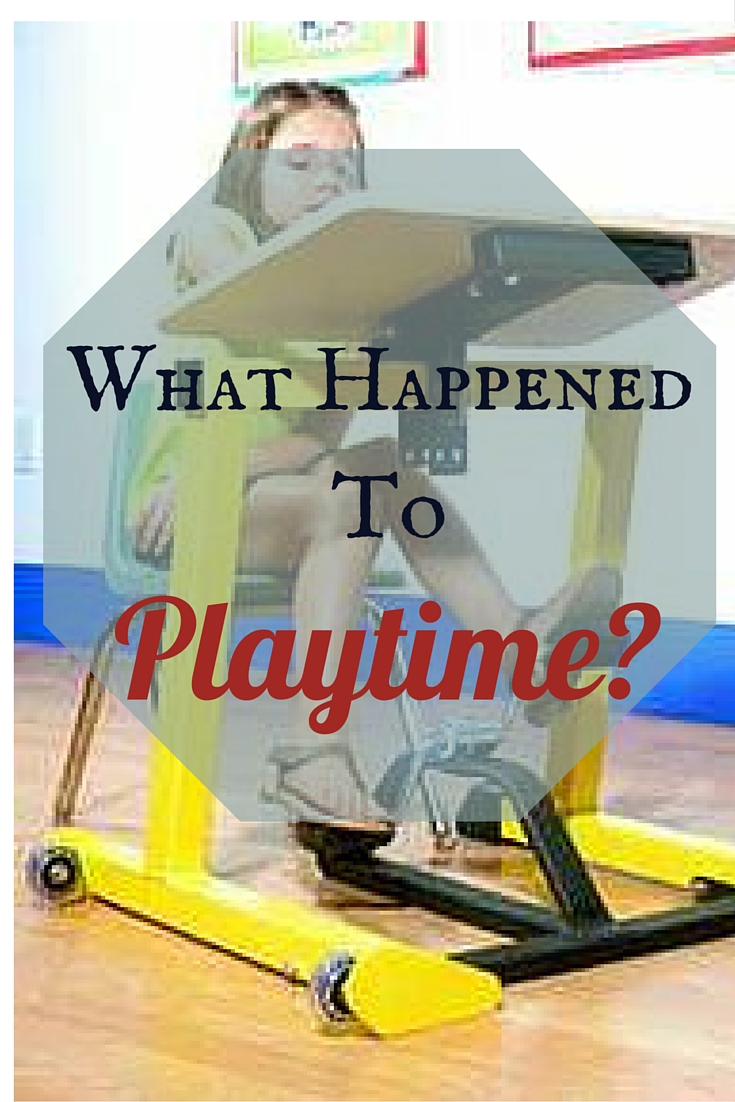
What Happened To Playtime? - Pedal Bikes Make Kindergarten More Like a Sweatshop

If you picture the ideal kindergarten classroom, what images come to mind? Circle time, with all the kids sitting criss-cross applesauce on the floor? Dress up areas and art centers and sensory tables? Free play outside where kids are swinging and jumping rope and playing tag?

WRONG!

We can't have 4 and 5 year-olds wasting precious instruction time with all of that non-testable bullcrap. It's never too early to start focusing on "instructional rigor" and "college readiness". That's why Kentucky elementary school teacher, Faith Harrelson, asked Owensboro Public Schools for "pedal desks" in her classroom. They look kinda like normal desks, but with hidden bicycle pedals underneath, so energetic kids can pedal while they diligently work math problems.

Kindergartners are notoriously fidgety with short attention spans. Their little growing bodies crave movement. It's hard to get even the most focused ones to sit still and pay attention for more than 5 seconds without getting up and running around the room. Kindergarten teachers have a hard time forcing their young charges to sit and "learn" and do "seatwork". (Which is incredibly important because the clock is ticking and college is just around the corner!)

Public school already resembles a glorified sweatshop for children these days, with kids and teachers busting their backsides for performance-based funding. Standardized tests are the measure for performance and effectiveness. Every waking moment must be spent in preparation for THE TEST. It leaves very little time for developmentally appropriate activities or self-directed learning.

Small children were not meant to spend their days trapped behind desks (whether those desks have pedals or not), being passively instructed, made to sit still and take tests. They need to be free to move, to organize their own games, to be outdoors.

They need to PLAY.

4 and 5 year-olds are smack dab in the middle of a wondrous opportunity for brain development, and researchers are finding more and more that time on the playground may be more important than time in the classroom. Sergio Pellis, a researcher at University of Lethbridge in Alberta, Canada states, "The experience of play changes the connections of the neurons at the front end of your brain, and without play experience, those neurons aren't changed." In other words, without play, children aren't getting fully developed brains.

The changes that childhood play has on the brain help wire it's executive control center, which plays a major role in planning, problem-solving, and regulating emotions. According to Pellis, play makes the young brain ready for life, love... and even schoolwork.

While Karen Harrelson claims her classroom's new pedal desks allow more student movement, which "activates cells in the brain" and cause a "shift in student engagement", maybe adding some free play to the children's schedules would have been more beneficial... perhaps even having a positive effect on those highly important and coveted test scores. It certainly would have been a lot cheaper.

But maybe if we just hook those bike desks up to the power grid it could help offset their  $12,000 price tag...

Not to mention make the classroom look more like the child labor factories they've become.

Thursday, December 17, 2015

Does This Look Like A Path To Prison?

On Sunday, Senator Bernie Sanders tweeted this:


 It sounds right. It might even hit you right in the feels. No one should have to struggle to fund their own education. And as someone who received generous scholarships, but still had to hold down two part-time jobs AND borrow an insane amount of money to juice my own degree, you might think I would agree with him. I'm also the mother of four children with no idea of how to pay for their four-year university stints. Free college is an attractive and alluring concept... sort of.

At least in his tweet, with the assertion that college is cheaper than prison, Senator Sanders acknowledges that SOMEONE is going to have to fund all of that free education. But he's right... sort of. The average annual cost of college tuition falls in the $20,000 to $35,000 range (It's only $9,410 for state residents attending public colleges. But let's not forget that figure is out-of-pocket for students. Those schools are already taxpayer-funded). The cost of incarceration falls somewhere between $20,000 to $40,000 per prisoner annually.

Seems like the expense is pretty comparable.

However, when we take into consideration the average time spent on a college degree (six years) and compare it with the average length of a prison stay (surprisingly only 2.9 years), it is easy to conclude that sending young people on a path to prison might be more cost-efficient.

Of course I'm being snarky... sort of. Crunching numbers like that doesn't take into consideration which group contributes more to society. However, the number of college students graduating with crippling debt and few marketable skills is mind-numbing. The Economic Policy Institute reports that 16.8 percent of new college graduates are "underemployed".

Cost to the American taxpayer aside, there is one other problem with Senator Sanders' tweet: the implication that a path to prison is the most likely alternative to a path to college.

Mike Rowe, from Dirty Jobs fame, has already given a marvelous rebuttal to Senator Sanders' college-is-the-only-path-to-success sentiment. Not everyone needs to go to college. Not everyone should go to college. And the statistics show that a college education isn't a fool-proof ticket to the big times.

There are many other available paths, none of which lead directly to prison. Mike Rowe is a big proponent of trade schools and hard work. But there is another path that no one is talking about.

I find it incredibly ironic that the day after Bernie Sanders' controversial tweet this happened...


That is my oldest taking his oath of enlistment in the United States Army. He has rejected the social message that the only path to success and happiness involves college degrees and student loan debt. 

But this doesn't look like a path to prison to me. What do you think Mr. Sanders?


Wednesday, December 9, 2015

Hell Week (AKA Standardized Testing)

This week we are in the middle of Hell.

Actually, it's just the administration of the California Achievement Test (CAT)... but it feels like Hell.

The lovely state of North Carolina requires that every student enrolled in home school take a nationally recognized standardized test each school year. Our chosen form of torture is the CAT.

We don't do anything special to prepare for the test administration. No reviews or lessons on test-taking strategies. We just sit at the dining room table with number 2 pencils and a timer. You would think it would be pretty stress free. You would be wrong.

The youngest child has dissolved into tears on at least three different occasions. She's the epitome of a virgo perfectionist. She struggles over each and every question, even the easy ones, pencil poised above the bubble sheet, paralyzed with fear that she will mark the wrong answer. She cries when she's frustrated. I hate that testing makes her cry.

Her older brother zips through the sections like it's a race. He would rather be doing other things. Anything really. He has slammed the test booklet shut and escaped the room before time is up on every single test section. He has no desire to check his answers, no stress over how well he's done. He's just happy to be finished.

They have two very different test-taking personalities. Which one is more effective?

Watching them test makes me wonder just how well the test measures their knowledge. Because it doesn't matter how many fraction problems they've completed correctly at that dining room table in the past. It doesn't matter how well they comprehend what they read or how well they punctuate their writing on any other day. The only thing that the test measures is if they answer the questions correctly. It doesn't measure how well they know the material because when the test is rushed through or constantly second-guessed through tears and fear, how well does that measure real knowledge and thinking skills?

No. The test measures how well students take a test.

Meanwhile, my oldest daughter who is currently enrolled in an early college high school program, is wading through exam review. Next week is semester finals. The school dedicates two weeks of instruction time for exam review. She has to watch an informational video on testing rules for each exam she has to take. The same video. Over and over. The same video she watched last semester. And the semester before that.

That's two weeks of her education every semester focused on taking a test. Not on learning important information or math concepts or critical thinking. Two whole weeks committed to ensuring testing success.

In North Carolina, those standardized tests determine teacher effectiveness and student success. They even influence teacher bonuses and school funding.

But it doesn't measure learning. It measures how well the students take a test.

Makes me wonder how many students are like my younger daughter, agonizing and questioning herself over every single item. Or how many are like my son, flying through without really caring how well they perform.

How are either of those tests a true measure of knowledge? They aren't, but the Powers That Be say we must take them. So we'll walk through this week of Hell just to get back to the real learning... which is exactly what those poor public school kids are doing this week, too.

Happy Hell Week, everyone. Godspeed.

Monday, November 30, 2015

Testing Doesn't Determine Success

It all started with a Facebook post. I was just innocently scrolling through my newsfeed when I saw it: a "friend's" post about her score on an online IQ test. You might question the IQ of someone who believes online IQ tests are a valid measure of intelligence, especially when that person posts their results for all of their cyber friends to see. You might also feel sorry for someone who needs to validate themselves so publicly in such a shallow and meaningless way.

Then, over the long Thanksgiving weekend, it got worse. My oldest son announced to family and friends that he is enlisting in the U.S. Army. (He's already qualified. He's taken the ASVAB and his physical, and passed his psychological evaluation. He's good to go, just needs to sign a contract.) Upon hearing his news, more than one person asked him what he scored on the ASVAB (Armed Services Vocational Aptitude Battery)... then felt the need to tell him about their much higher score. (Nice people skills!)

Perhaps it's because we've been programmed through our entire school careers to believe that scoring well on a test is the ultimate goal. There is such an emphasis on successful standardized testing that our children suffer from anxiety. Often teacher pay and school funding is affected by student test performance. There's a lot at stake. Students are run through mock practice tests and weeks upon weeks of test review. Lessons about test taking strategies trump more effective and interesting forms of instruction because ALL THAT MATTERS IS THE TEST. Just score well on the test and everything will be fine.

It's a lie. Tests measure how well someone takes a test. That's it. They don't measure motivation or character or ambition. Tests don't measure creativity or will power or self-reliance. They don't measure passion or confidence or communication skills.

How well a person scores on a standardized test (or even stupid internet IQ tests) do not determine success. High IQ scores or ASVAB scores or even SAT scores are not good indicators of where a person is headed in life. A great test score is just a great test score until that person does something with it.

A high test score does not mean everything will be fine. It doesn't mean that a person has the skills to be successful. It doesn't indicate how happy they will be, or how much money they will make, or how much they will contribute to society.

There are a lot of seriously smart people out there, some of them could probably ace the ASVAB (Let's not even get into cheesy internet IQ tests here) with their eyes closed. But if those super-smart people are lounging around couch potato-style what value are they really contributing to society? (I'm talking to you here, internet IQ bragger wallowing in debt, stuck in a dead end job, and working on your third failed marriage!)

I told my son not to worry about those people who needed to brag about their test scores. What are they doing with those test scores (other than attempting to make him feel inferior)? Did they join the military?

By just joining the United States military, my son has made himself part of an elite group. A very small percentage of people join. The numbers vary, but the consensus seems to be around 2 percent of the population.

He's already set himself apart from the average, test-taking American by enlisting. Sure his score might not be as high as Billy Bragger's, but he qualified, and he's doing something with it. It's the other qualities that the test doesn't measure that will make him a successful soldier and a successful person.

Taking the test and doing something with the knowledge it supposedly measures are two very different things.

Billy's score is just a number, albeit a very high number, on a piece of paper.

My son's is a ticket to his goals.

Monday, November 23, 2015

Fighting Aliteracy - #OffTheShelfie

"The man who does not read good books has no advantage over the man who can't read them."
~Mark Twain (or someone else depending on who you believe on the internet)

The average American doesn't read much, unless you count Facebook status updates, Twitter hashtags, and cheesy inspirational quotes. The Pew Research Center reported in 2014 that 23% of American adults hadn't cracked open a book (or even an ebook) in over a year.

That statistic might send you into a happy dance of hope for the population. It does mean that 77% of Americans are readers. Right?

Wrong. Most of the people surveyed read only a meager 5 or fewer books in a twelve month period. That's right, only 45% of adults managed to read more that 5 books in a year. It's really no wonder, considering most of their time is spent staring at electronic devices. Nielson reports that Americans spend 11 plus hours each day using electronic media. How many hours of Angry Birds can one person stomach in a 24 hour period?

It's called aliteracy.

In spite of all the hours of compulsory schooling and standardized testing and government-mandated curriculum, our educational system is not producing readers. Even if a child graduates as a functionally literate human being, if that child doesn't read, what has his education afforded him?

I may just be another person who believes that television and the internet have forced American culture into a dystopian post-literate wasteland of reality TV shows, stupid cat memes, and internet selfies, but the average American just isn't reading.

I don't want to be average.

I know there are other readers out there, hiding somewhere behind and between the cat memes and the vacuous selfies. And speaking of selfies, the books a person chooses to read (or not to read) reveal far more about them than staged self-portraits caught with their smart phones.

I love the idea of plastering the internet with "shelfies", pictures of our book collections for the world to see. But just because someone has a shelf full of books, doesn't mean they actually read them. Just because you own something, doesn't mean you use it regularly. (Take my vacuum cleaner for example.) Those books actually have to come off the shelf for them to do any good, in order for them to stimulate brain cells and imagination, to cause personal, intellectual, or spiritual growth.

Here's a better selfie...
I'm calling it an "off the shelfie"

It's a picture of me with my current reading selection. This book, American Sniper, isn't a typical reading choice for me. It came off the shelf because my oldest son desperately wants to be an Army ranger. I wanted a glimpse inside of what it's like to serve on an elite fighting force. Yes, I am aware that Chris Kyle was a Navy SEAL, but there aren't currently any best selling books about Army rangers (Come on, Army rangers! Step up your game!), so here I am.

My impressions: war is Hell... and Navy SEALS might be a little bit crazy.

So there is my proof that I am currently fighting against American apathy. I'd love to see what everyone else is reading. Tell me in the comments. Better yet, send me a picture of what you've taken "off the shelf". I want to see what other "different than average" people are reading. And share those "off the shelfies" (#OffTheShelfie) for the internet to behold. (My teenage daughter is so going to roll her eyes at my cheesy hashtag.)


Thursday, October 1, 2015

"Beat the Boys" - How Michelle Obama's Message Harms Our Boys AND Our Girls

The First Lady of the United States, Michelle Obama, took to the stage Tuesday in rock star fashion. The audience was comprised of screaming school girl fans taking part in an event sponsored by Glamour magazine. Sporting fashionable footwear and shrouded in pink-hued spotlights, Obama shared high fives with famous actress Charlize Theron and spouted plenty of Instagram-worthy life lesson quotables.

Women and young girls have been basing their life choices on Glamour magazine for generations, so we should obviously take an event they sponsor with every ounce of seriousness we can muster.

Michelle (and her stage buddies) gave plenty of valuable advice to the impressionable young girls in the audience on subjects like relationships and sex appeal. However, education was the main highlight of the event which was thrown to publicize Obama's "Let Girls Learn" campaign.

"Compete with the boys. Beat the boys."

While I can easily get behind FLOTUS's initiative to educate girls around the world who are regularly denied an education, this piece of advice given to United States school girls makes me shudder in disgust.

As the mother of two daughters, I cringe. Once again, we've set males at the gold standard level. We've waved an assumption at our daughters that boys are the ones succeeding, the ones who are capable, and that if they can just reach their level, they will have made it.  What if they are capable of more than the boys around them? Allowing our girls to set their own standards of achievement and success validates them as individuals. It puts the power of choice and the success of their education in their own hands... not the hands of their male peers.

I want my daughters to define themselves. I do not want their self-worth based on how they compare to boys.

As a mother of sons, I cringe even more. "Beat the boys" sets a generation of young men up as the enemy, a force to be subdued at all costs. Sure boys can be kind of stinky, but they aren't the bad guys. Boys are already trapped in an education system that all too often fails them. Statistically speaking, boys now lag behind girls on almost every academic measure. They are more likely to be drugged (for hyperactivity "disorders"), more likely to get in trouble, and more likely to drop out of school than their female peers. 70% of students in special education are male, and 25% fewer men than women graduate from college.

Really not very much of a gold standard when you think about it. When the statistics are laid out bare for everyone to see, it doesn't seem like "beating the boys" is all that difficult a task. Maybe it's the boys in this country who need the interventions and the Glamour magazine-sponsored pep talks.

Maybe it's our sons that we are failing, not our daughters. Here in America, it is our boys who are largely being denied an education.

But that doesn't fit the feminist narrative.

It doesn't sound like FLOTUS is all that concerned about girls succeeding in school. It sounds like she wants them to have bragging rights. "Beat the boys" isn't about equal rights. Now we want girls striving to be the ones succeeding and in power, that men by default should be inferior. This is why so many women (and men) can't stomach the feminism label. Our boys of today can't atone for the generations of misogyny of which their forefathers may be guilty. It doesn't work that way.

Ultimately, I'm upset that someone with such an audible platform chose to reduce education to a competition. Learning isn't all achievement. It isn't just staying in school, earning A's and being better than the kid in the desk next to you. Learning is an ongoing process of life-experiences and exposure to new ideas and concepts. It is interacting with one's environment and expanding consciousness. It's not excelling at standardized tests so you can bust through the mythical glass ceiling.

Perhaps Michelle's heart is in the right place. She doesn't want girls to be afraid of academic success. I get that. I certainly don't want my girls to hold themselves back from doing their personal best just because of what others might think of them. But there are so many other better messages she could have chosen, messages of hope, love, and positive encouragement.

"Follow your dreams."

"Do your best."

"You can be whatever you want to be if you work hard enough."

Instead she chose a negative message to promote a positive cause. Interestingly, I learned in school that a negative times a positive is still a negative... and I'm just a girl.

Michelle Obama is just another politician who chooses to divide the masses instead of uniting them in a worthy cause.

But at least she got a nifty hashtag out of it.

Thursday, September 17, 2015

It's Not Because He's Muslim! - How Treating Kids Like Criminals Breeds Violence

On Monday, a fourteen year-old high school student was handcuffed, interrogated, made to pose for mugshots, and humiliated all for bringing a homemade clock to school. Even worse... he was suspended.

Apparently, homemade clocks can look a lot like homemade bombs, causing teachers and administrators and police to blow things out of proportion. (See what I did there?)

While the media would like us to believe that Ahmed Mohamed's "invention" was overblown because of his exotically Muslim name and Arabic features (not to mention his family's religion. The Mohameds are definitely NOT Presbyterians), I beg to differ.

Sure we like to explode over racial and ethnic injustices, and Muslims with homemade bombs are easy to blast, but let us not forget the 16 year-old Florida honor student charged with two felonies for a simple science experiment, or the Texas student arrested for uploading a school map to a video game, or the 11 year-old expelled for bringing a maple leaf to school (Easy to mistake those maple leaves for marijuana apparently... I knew those Canadians looked suspicious. They are way too happy.), or the 10 year-old suspended for wielding his fingers like a gun, or the 7 year-old who nibbled his pop tart into the shape of a deadly firearm and was suspended.

This isn't about Ahmed's skin color or religion or his Sudanese background, in spite of what CNN and MSNBC might have us all believing. This is about stupid zero tolerance policies.

You see, here in America, we like to treat our school kids like criminals.

I realize that schools have to take even overtly ridiculous bomb threats seriously because of the public explosion that would ensue should the threat turn out to be real. The same media that has been set-off by the overblown treatment of Ahmed's bomb-mistaken clock would have mushroomed (So many bomb puns, so little time) to epic proportions had the clock actually turned out to be a bomb and they hadn't taken it seriously. (It's kind of a lose/lose situation for the schools... which might be why any outside learning is so often discouraged. Leave your curiosity and ingenuity at home, kids. That stuff doesn't belong in school.)

When did creativity and curiosity become criminal? When did schools start calling in the police before they even issue a call home to parents? When did simple behavioral issues start being treated like crimes?

No, it's not Ahmed's religion that landed him in cuffs. Even though I've yet to read a "news" story without the word "Muslim" in the headline, it's not about that. The children mentioned above were black, Chinese, and good ol' card-carrying members of white privilege. The insanity of zero tolerance knows no boundaries of race, religion, or socio-economic background.

The effects of these overblown bursts of insanity is far-reaching. There is the money the parents must fork out for lawyers and court costs to defend their children, time missed in school, children falling behind (You know that's going to affect their test scores), the possible criminal records that will follow these children through their entire lives, not to mention the psychological stress.

But these situations seem to sum up nicely the mindset of twilight America. We have an education system that is more devoted to brutal and monstrously idiotic authority than it is to actually teaching. We thrive on violence and punishment rather than creativity and compassion. When we are obsessed with violence, it's easy to see the threat of it around every corner, even in the hallowed halls of education. In fact, we are consumed by a fear of violence and guns so extreme it almost outmatches the fear of witches in historic Europe and colonial America.

The truth is, zero tolerance policies do nothing to protect kids. Punishing kids who bring bubble guns to school and shout "bang, bang" on the playground isn't preventing the next mass shooting. In fact, it could be doing quite the opposite. Treating students like criminal suspects is a fabulous way to breed contempt, paranoia, and fear... all of which ultimately lead to violence. Day after day of forced conformity, bag inspections, metal detectors, and locker searches are enough to make just about any kid snap. At best they'll hate their schools. At worst they'll be entertaining fantasies of mowing down their oppressors.

It's time we stopped tolerating zero tolerance policies... or the next school shooting might just look more like a prison rebellion or a slave uprising.

I hope Ahmed's clock wasn't set for a count down.